
How Does Tarot Work? An Honest Answer
Tarot has no proven power to predict events, and it can still help you think. Here is how pictures, chance, structure and a pen do the work.
If you have ever sat with a reading that seemed to understand you, it is natural to wonder what just happened. Did the cards know something? Was it coincidence? Or were you doing more of the work than you realized?
The honest answer comes first. There is no good evidence that tarot predicts events or reveals hidden facts about your life or anyone else's. What tarot can do is help you think. A deck of 78 detailed pictures, drawn at random and laid out in a simple structure, is a surprisingly good way to look at a problem from somewhere new. The rest of this article explains how that works, and where it stops.
So, is tarot real?
Tarot cards are real objects with a real history, and the experience of a meaningful reading is real too. What has not been shown is that the cards carry information from outside you. When a reading feels accurate, the most likely reason is that you recognized something in it, because a card's meaning only becomes specific once you connect it to your own situation.
That is not a dismissal. It moves the interesting part of a reading from the deck to the person holding it. We look more closely at prediction, including where the fortune-telling idea came from and why readings can feel uncanny, in Can tarot predict the future? This article picks up from there and asks a different question: if the cards are not seeing anything, what are they doing?
People also hold spiritual views
Many people experience tarot as spiritual. Some feel guided by intuition, by spirit, or by something they would call the divine, and for them a reading is closer to prayer or meditation than to an exercise. We respect that, and nothing here asks anyone to give it up.
We simply do not make claims on the deck's behalf. On this site we describe tarot as a mirror, because that description holds whatever you believe. If you see the cards as sacred, the reflective habits below still apply. If you see them as printed cardboard, those same habits are the whole story, and they are enough to make tarot worth your time.
Four things that make a reading work
Rich pictures invite you to fill them in
Most cards in the Rider-Waite-Smith deck show a person in the middle of something, with details that can be read more than one way. Nobody tells you exactly what the figure feels. You supply that, and what you supply tends to come from your own concerns.
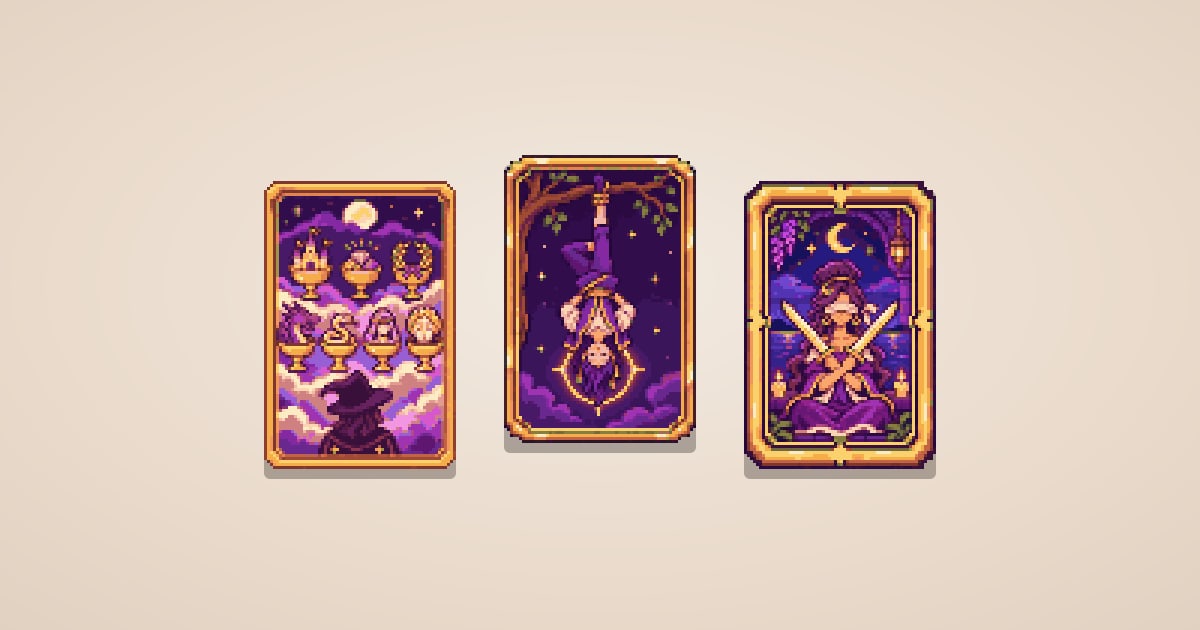
The Seven of Cups is almost a picture of this process. A figure seen from behind looks up at seven cups resting on a bank of cloud, and every cup holds its own vision. There is a dragon, a coiled snake, jewels spilling over the rim, a small castle, a laurel wreath, a head, and a shrouded figure that seems to glow. Waite described them as "images of reflection". Show the card to five people and they will notice different cups first. The one that catches your eye says something about what is on your mind, and that is useful material.
A random card interrupts habitual thinking
When you are stuck on a problem, your thoughts tend to run in the same groove. You rehearse the same arguments and arrive at the same worries. A card you did not choose drops into that loop from an odd angle. It asks you to connect your situation with an image you would never have picked, and the effort of making that connection can shake loose a thought you had been stepping around.
The Hanged Man shows the idea neatly. A man hangs upside down by one foot, his face calm, a halo around his head. Many readers take the card as a sign to look at things the other way up. Chance does something similar for a reading: it turns the question around before you have a chance to defend your usual answer.
This is also why the randomness does not need to be mysterious to be valuable. A good shuffle gives you a prompt that you could not have planned.
Positions give a problem a shape
A spread assigns each card a job: what is happening, what is in the way, what might help. Even before you look at a picture, those positions break a tangled problem into smaller questions you can actually answer. "Everything about work feels wrong" becomes three separate things to look at, and each one is easier to hold.
The Two of Swords, a seated figure, eyes covered, balancing a pair of crossed blades against a quiet sea, often comes up around decisions that feel frozen. A simple two-position layout, one card for each option, can be enough to make a stalemate easier to discuss with yourself. You can browse ready-made layouts on our tarot spreads page, or learn to build your own spread around the questions you need.
Writing it down builds self-knowledge
A reading you only think about fades by evening. A reading you write down becomes a record you can return to. Over weeks, a journal shows which themes keep coming up, which worries turned out smaller than they felt, and which choices you made after a card got you thinking.
A written record also keeps you honest. You can see the readings that pointed nowhere alongside the ones that hit home, which is a fairer picture than memory gives. Our guide to starting a tarot journal and the printable journal templates make the habit simple to begin.
An illustrative reading
Try it for yourself: the swap test
If you want to see how tarot works in your own hands, this small experiment shows it clearly. It is as useful to skeptics as to people who already love their deck.
Where the mirror stops
Because the cards work through your own thinking, they cannot know things you have no way of knowing. A reading cannot tell you what another person privately feels, whether a test result will be good, or how a legal or money problem will turn out. Those questions need real information and, often, real help from a doctor, a lawyer, an adviser or a counselor.
It is also worth noticing how a reading leaves you. If you keep pulling extra cards hoping for reassurance, or a card leaves you more frightened than before, that is a good moment to put the deck down. Our safety page has gentle guidance and places to find support, and on a heavy day a single card for a hard day may be all you need.
So, how does tarot work?
Tarot works the way a good question works. It gives you an image to react to, a nudge out of your usual thinking, a simple frame to sort a problem into, and a reason to write down what you discover. None of that requires the cards to know anything. All of it depends on you being willing to look.
If you would like to try, start with one card a day from our card of the day or a short free reading, and write a line or two afterward. The free Learn Tarot course goes further, including lessons on the Major Arcana and reversed cards. If you like keeping notes on your phone, the Emberlune app can keep your readings in a private journal, where Luna is there to talk them over with you.
Keep reading
-
 Learn TarotCan Tarot Predict the Future? A Thoughtful Look at What Tarot Can and Cannot DoWhere the idea came from, what readers actually believe, why readings can feel uncannily accurate, and how to use the cards without handing them your choices.
-
 Self-DiscoveryHow to Start a Tarot Journal You'll Actually Want to KeepA five-line entry you can write in two minutes, how to spot the cards that keep coming back, and what to do when you read old pages.
-
 Learn TarotHow to Choose Your First Tarot Deck: What Actually MattersThere is no correct first deck, only one you will want to pick up again. Here is what to look for, and how to practice for free before buying anything.