
Can You Read Tarot for Yourself? Yes, and Here Is How to Do It Honestly
Most people learn the cards by reading for themselves. The real difficulty is not luck or permission but the part of us that wants a particular answer.
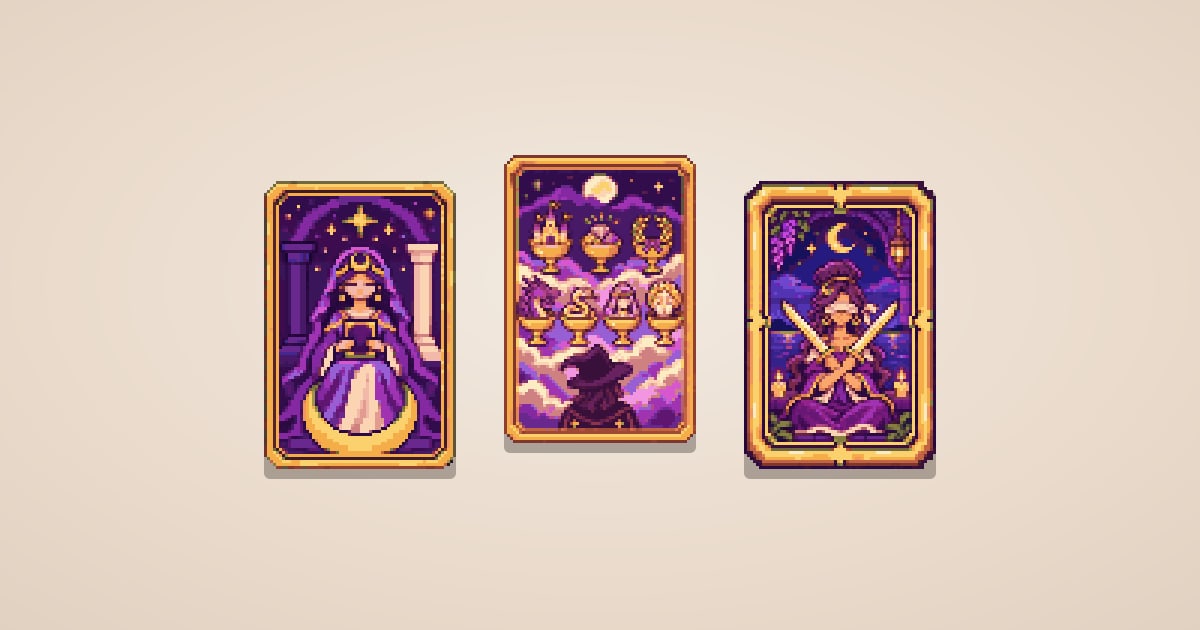
Yes, you can read tarot for yourself. Plenty of people do, and for many it is the main way they use the cards: a quiet draw in the morning, a small spread on a hard evening, a few lines in a notebook afterward. Reading for yourself is also how most people learn, because you are the one person who is always available to practice on and who knows the whole context of every question.
So the short answer is yes. The longer answer is about doing it well. Reading your own cards has one real difficulty, and it has nothing to do with luck or with who bought your deck. It is that you already care about the answer.
The superstitions, gently
If you have searched this question, you have probably met a few warnings. Reading for yourself is bad luck. A deck only works if someone gives it to you. You should never read your own cards, or only on certain days, or only after a cleansing ritual.
These are pieces of folklore, passed from reader to reader and repeated in books, forums and videos. No rule of tarot requires them, and they vary a lot depending on who is telling them. Some people find meaning in customs like these, the way some people like to knock on wood, and there is no harm in keeping a ritual that makes your practice feel cared for.
But there is nothing to fear here. Tarot at Emberlune is a mirror for thinking, not a way to see the future, so there is no mechanism by which reading your own cards could bring misfortune. A deck you bought for yourself works exactly as well as one you were given. If you want the longer version of why the cards do not predict events, our article on whether tarot can predict the future goes through it.
The real challenge: you want something
When you read for a friend, you can look at the cards with a little distance. When you read for yourself, you sit down already hoping. You hope the relationship will work out, the job will come through, the worry is nothing. That hope is human and nothing to be ashamed of, but it bends what you see.
Psychologists call one version of this confirmation bias: the habit of noticing and favoring whatever fits what we already believe or want. In a reading it looks like this. A card with several possible meanings shows up, and you choose the meaning that agrees with you. A card you dislike appears, and you quietly decide it belongs to someone else in the story. You draw a hard card, shuffle again "to clarify," and stop when a kinder one arrives.
The Seven of Cups is a good picture of this. A figure stands in shadow before seven cups floating in a cloud, each holding something different: a castle, jewels, a wreath, a snake, a dragon, a face, a veiled shape. Waite connected the card with imagination and "images of reflection," and noted that nothing "permanent or substantial" is promised. When you read for yourself, every cup can look like the one you wanted.
The Two of Swords shows the other side. A blindfolded woman sits with two swords crossed over her chest, the sea behind her. Sometimes, reading for ourselves, we are not wishing so much as refusing to look. Both are normal. Both are easier to catch when you have a few habits in place.
Seven habits for honest self-readings
None of these are rules. They are small frictions that slow you down just enough to notice what you are doing.
- Write the question before you shuffle. A question kept only in your head can change shape after the cards appear. Written down, it stays put. If you need help with wording, our list of questions to ask tarot cards has plenty.
- Ask open questions. "Will they come back?" invites you to read the cards as a verdict, and you will lean toward the verdict you want. "What do I need to understand about how I feel since they left?" gives you something you can actually work with.
- Describe the picture before the meaning. Before you think about what a card means, say what is drawn on it: who is there, what they are doing, what the weather is like, what catches your eye. This gives your attention something real to hold before your hopes take over.
- Notice the card you want to explain away. If one card in a spread makes you think "that one doesn't count," stay with it for a minute longer. It is often the most useful card on the table.
- Do not redraw for a better answer. If a card disappoints you, that disappointment is information about what you were hoping for. Write it down instead of shuffling again.
- Write it down and revisit in a week. A reading changes when you look at it a week later, with the feeling of the moment gone. You will often see what you skipped over. The tarot journal templates give you a simple place to start.
- Step away when you are anxious. If you are reading because you cannot stand not knowing, the cards will rarely calm you down for long. Closing the deck is a perfectly good choice.
Try one honest reading
When reading for yourself is not the right tool
Some questions are too heavy for a quiet draw at the kitchen table. If you are grieving, frightened, or in the middle of a decision with serious consequences for your health, money or safety, a reading can be one way of sorting your thoughts, but it should not be the only one. Talk to people you trust and to someone qualified where that applies.
Notice, too, if reading starts to feel compulsive: drawing again and again on the same question, or feeling worse each time you close the deck. That is a sign to rest the cards for a while. There is no rule about how long. Our safety page has helplines and some gentle guidance, and if today is simply a hard day, a card for a hard day offers something softer than a full reading.
A practice of your own
Reading for yourself can be one of the kindest uses of tarot. It gives you a few minutes to sit with a question, look at a picture, and put into words something you may not have said out loud. You do not need permission, a gifted deck or a special talent. You need a question, some patience with the cards you would rather not see, and somewhere to write things down.
If you would like company with that last part, the Emberlune app keeps a private journal of your readings, and you can talk them over with Luna there. A paper notebook works just as well. What matters is that you come back and read what you wrote, a week later, with fresh eyes.
If you are just starting out, our guide to how to read tarot cards covers the basics, and the tarot card of the day is an easy, low-stakes way to practice one card at a time.
Keep reading
-
 Self-DiscoveryHow to Start a Tarot Journal You'll Actually Want to KeepA five-line entry you can write in two minutes, how to spot the cards that keep coming back, and what to do when you read old pages.
-
 Learn TarotQuestions to Ask Tarot Cards: 60 Gentle Questions That Actually WorkA question bank for the days when you want to draw a card but cannot quite find the words.
-
 Self-DiscoveryA Morning Tarot Ritual: A Gentle Five-Minute Daily PracticeOne card with your tea or coffee, three plain questions and a line in a notebook, kept small enough that a missed morning never feels like failing.