
Tarot for Creativity: Prompts, Exercises and a Spread for Creative Blocks
The cards are 78 small pictures full of people, weather and objects, which makes them a generous source of ideas when the page stays blank.
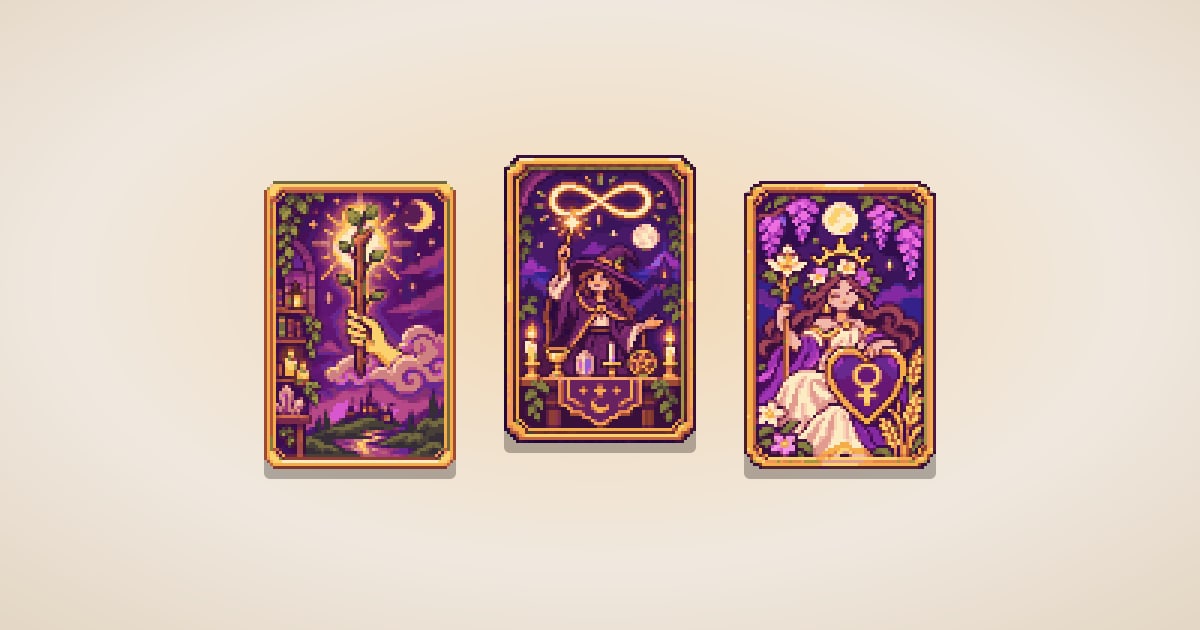
If you are stuck on a story, a painting, a song or a project you care about, tarot can help in a very ordinary way: it hands you pictures. Each card is a little scene with a figure, a gesture, a landscape and a few strange objects. Pull one, and you have something to respond to instead of an empty page.
That is the honest pitch. The cards will not tell you whether your novel will sell or whether you are "meant" to be an artist. What they can do is break the loop of staring at the same blank space, give your imagination a constraint to push against, and nudge you to ask better questions about why the work feels stuck. Below are three exercises, a short spread for creative blocks, and six cards that often come up in conversations about making things.
Why random pictures help when you are stuck
A blank page offers every possibility at once, and that can be paralyzing. A single card narrows things down. Suddenly you are not writing "a story", you are writing about someone holding up a cup with a fish looking out of it. Your mind starts asking who, why and what next, and those questions are where work begins.
Writers have played with tarot this way for a long time. Italo Calvino built The Castle of Crossed Destinies around travelers who cannot speak and tell their stories by laying tarot cards on a table. You do not need any of that ambition. You only need a deck, a notebook and ten minutes.
You also do not need the traditional meanings: for creative work, the picture matters more than the keyword. For background, the Learn Tarot course and the tarot glossary are there.
Three exercises for writers, artists and anyone stuck
1. Build a character from a court card
Every court card is a portrait: sixteen of them, Page to King in each suit. Pull one at random and treat the figure as a person you are meeting for the first time. Describe only what you can see: clothes, posture, where they are looking, what they hold, what the land behind them is like. Then start inventing. What do they want? What are they hiding? What would they never say out loud?
2. Tell a story from three cards
Shuffle, draw three cards and lay them left to right as beginning, middle and end. Write the plainest possible version first, one sentence per card. Then rewrite it, letting the cards argue with each other. If the middle card does not fit, that friction is useful: stories need a turn.
Add a constraint: use only the objects in the cards, tell it from the point of view of a background figure or an animal, or write it as a letter. Our guide to reading card combinations has more ways to let two pictures talk to each other.
3. Make a mood board from one suit
Take out all fourteen cards of one suit and lay them face up. Do not read them; just look. Note colors, weather, materials, gestures and repeated objects. The Cups are full of water, from the streams spilling over the Ace to the sea behind the Page. The Swords have big skies and moving clouds. The Pentacles keep returning to gardens, workshops and coins. The Wands carry living wood with leaves still growing on it.
Write ten nouns and five colors from the spread, and use them as a palette: for a sketch, a poem, a playlist, the setting of a scene. It helps when you know the mood but not the details.
A 3-card spread for a creative block
When the problem is not a lack of ideas but a stuck feeling about the work itself, a short spread can help you think it through. Shuffle, ask something like "What would help me get moving on this project?", and lay out three cards.
- Where my energy is. What part of you is still interested, curious or awake?
- What is in the way. A fear, a habit, a schedule, a standard you cannot meet yet.
- One small way to begin. Something you could do in fifteen minutes, today or tomorrow.
Read each card by its picture first and ask how it connects with your actual situation. The last position works best when it becomes a concrete action: write one bad paragraph, sketch the hands only, open the file and fix a single line. If you would like to adapt the positions, our guide to creating your own spread explains how, and there are more layouts on the tarot spreads page.
Cards that often speak to creative work
Any card can spark an idea, but some pictures seem made for people who make things. Here they are, described from their Rider-Waite-Smith images. Readers differ; keep what helps.
Ace of Wands
A hand reaches out of a cloud holding a thick wooden staff that is still sprouting green leaves, with a castle on a hill in the distance. Waite lists "creation, invention, enterprise" among its meanings. For a stuck maker, the detail worth noticing is that the wood is alive. The idea does not have to be finished; it only has to be growing. Read more on the Ace of Wands page.
The Magician
Behind a table, a young figure lifts a wand up high and points one finger at the ground, with a cup, a sword, a coin and a wand laid out in front of him. Roses and lilies grow around the table. Creatively, it is the card of using what you already have. You probably do not need a new app, a new notebook or a course before you start. The tools are on the table. See The Magician.
The Empress
A crowned woman sits on soft cushions among trees, a field of ripening grain at her feet and a waterfall behind her. Nothing here is hurried. Many readers link her with abundance and growth, and for creative work she can be a reminder of slow seasons: some projects need rest, food, walks and time before they are ready. She also appears in our essay on the Empress and taking care of yourself, and on The Empress card page.
Three of Pentacles
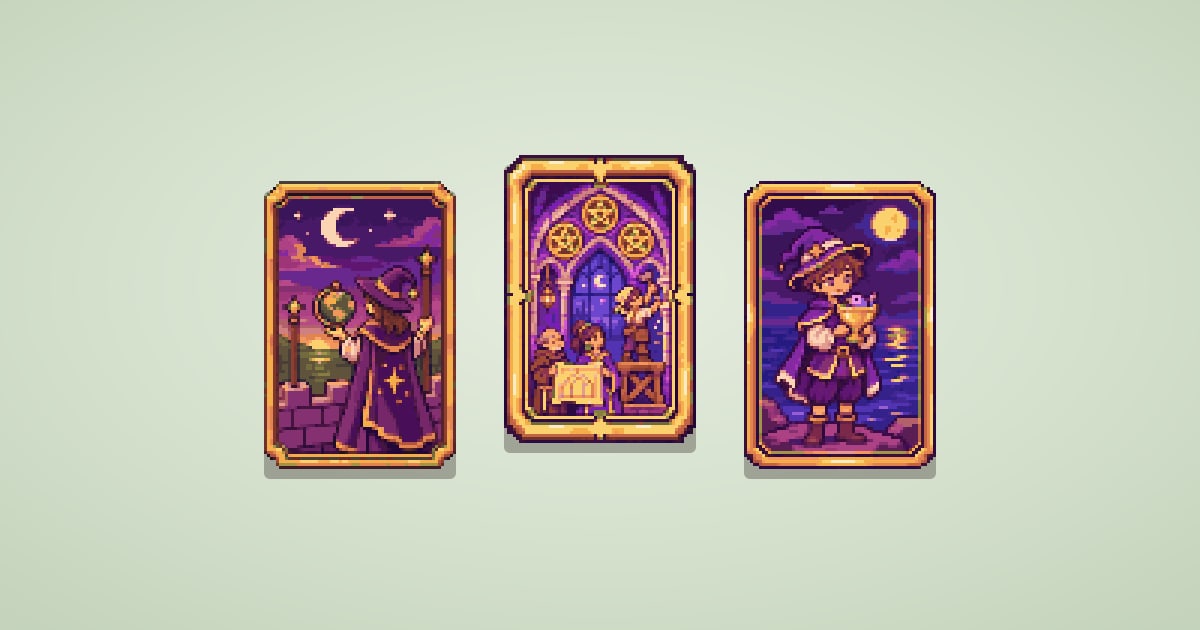
Inside a stone archway, a craftsperson stands on a bench working on the building while two other figures, one holding what looks like a drawn plan, consult with them. Waite describes "a sculptor at his work in a monastery." This is the card of collaboration and of skill built over time: asking for feedback, showing unfinished work, treating a creative practice as a trade you get better at. Visit the Three of Pentacles.
Page of Cups
A young figure in a flowered tunic stands by the sea, looking with mild surprise at a fish that has popped its head out of the cup they are holding. Waite's description ends with a lovely line: "It is the pictures of the mind taking form." This is the card of the odd idea that arrives uninvited. Write it down before you decide whether it is silly. More on the Page of Cups.
Seven of Cups
A dark silhouette faces seven cups floating in the clouds, and every cup offers its own vision: jewels, a snake, a castle, a dragon, a wreath, a face and a veiled glowing figure. Waite connects the card with imagination and "things seen in the glass of contemplation," while noting that nothing permanent is suggested. For makers it is a friendly warning about too many ideas at once. Choose one cup for now. The others will still be there. Read the Seven of Cups.
Keep it light
Creative blocks are often tangled up with tiredness, worry, money, grief or simply a full life. A card cannot fix those, and you do not owe the deck a breakthrough. If a draw feels discouraging, put it back and pull another prompt, or close the deck and go for a walk. If the block sits on top of something heavier, our safety page and the essay on tarot for anxiety might be gentler places to start.
If you want to try this today, draw a card of the day and write for ten minutes about the person or object in it. Keep what you make, even when it is rough. A notebook works, and so do our journal templates; in the Emberlune app, Luna saves each reading to your journal, so the knight with the undelivered coin is easy to find again next month. The point is simply to have one more page than you had yesterday.
Keep reading
-
 Learn TarotHow to Read Tarot Card Combinations: A Simple Method With 12 ExamplesGive each card a simple meaning, notice how they meet, and let your question turn two pictures into one useful thought.
-
 Tarot SpreadsHow to Create Your Own Tarot Spread (With Examples)Start from the question, write each position as a question of its own, test it once, and fix what doesn't work.
-
 Self-DiscoveryA Morning Tarot Ritual: A Gentle Five-Minute Daily PracticeOne card with your tea or coffee, three plain questions and a line in a notebook, kept small enough that a missed morning never feels like failing.