
The Wheel of Fortune and Living With Change
On the tarot card for change, the four creatures who keep reading while everything turns, and where to stand when life will not hold still.
 Wheel of Fortune · full meaning →
Some seasons, nothing stays where you left it. The rent goes up. The team you worked with for years is folded into another department. A parent's health shifts in the space of one phone call. A close friend moves across the country, and the Thursday dinners simply stop. Many of us have known a stretch like this, when very little of what is happening was our decision, and most of it arrived without asking whether we were ready.
It isn't always disaster. But the ground is moving, and there is nowhere obvious to put your feet.
The tarot has a card for exactly this, and it is one of the strangest pictures in the deck.
A wheel in the sky
As Pamela Colman Smith painted it in 1909, a great golden wheel hangs in open blue sky, resting on nothing. Around its outer ring are letters. Start in one place and they spell TARO; start in another and they spell ROTA, the Latin word for wheel. Between them sit four Hebrew letters, the name of God. Closer in, the spokes carry small alchemical signs, and at the very center is a little circle, the hub, where everything meets.
Three creatures travel with the wheel. On the left, a snake slips downward, head first. On the right, a red figure with the head of a jackal, usually read as the Egyptian god Anubis, is carried upward on the rim. And at the top, quite still, sits a blue sphinx holding a sword.
Then there are the corners. On four banks of cloud, one in each corner, sit four winged creatures: an angel, an eagle, a lion and a bull. Every one of them has an open book. Every one of them is reading.
A. E. Waite, who designed the deck with Smith, wrote very little about the picture itself. One line names the snake:
I have, however, presented Typhon in his serpent form.
Typhon is an old name for a monster of storm and disorder. So the falling side of the wheel has a face, and it is the face of things coming apart. The rising side has one too. Both travel with the same wheel, in the same turn, at the same time.
The ones who keep reading
It is easy to see only the wheel; the eye goes to the motion, as it does in life. But the four creatures in the corners may be the most comforting thing in the picture.
They are not watching the wheel, or trying to stop it, or guessing where the snake will be next. They have their books, and they are paying attention to them. Many readers connect the four with the fixed signs of the zodiac and with the four evangelists, and one thread runs through both readings: these are the parts of the picture that do not move.
They share the same sky as the wheel. Steadiness, in this picture, isn't distance from change. It is having something to attend to while it happens.
The same four appear again at the very end of the Major Arcana, in the corners of The World, around a figure dancing inside a wreath. They were there through the turning, and they are still there when the long story closes. Whatever else shifted, they stayed.
Hub and rim
Anyone who has ridden a playground roundabout knows how a wheel works from the inside. The children at the edge get flung and shriek. The one near the middle barely moves. Same wheel, same speed; where you sit changes everything.
The card's sphinx sits at the top, and yet it doesn't look as if it is riding the rim. It looks as if the wheel is turning beneath it. In many readings the sphinx stands for a kind of wisdom that stays calm while everything turns, and the hub at the center tells a similar story in plainer terms.
In a season of change, the rim is the circumstances: the job, the address, the diagnosis, the plans. The hub is smaller and quieter. It is the way you make tea, the voice you use with the people you love, the things you still care about when nothing else is certain. The rim carries you through the turn. The hub comes with you.
Waite's own divinatory meanings open with "Destiny, fortune, success", yet Emberlune reads the card a little differently. We don't treat the Wheel as a forecast of good luck or bad. What the picture offers is quieter and more useful: a way of standing while things move.
Small ways to stay near the middle
None of these will stop the wheel. They may make the ride a little gentler this week.
Keep one spoke the same. Choose one small daily thing and protect it from the change: the walk at the same hour, the same Sunday phone call, the same mug in the morning. When everything else is new, one unchanged ritual gives the day a center to turn around.
Find your book. The four creatures have something to read. Give yourself ten minutes a day with something absorbing that has nothing to do with the change: a novel, a crossword, a song you are learning, a sweater half knitted. Attention that rests somewhere steady is a kind of rest.
Pour slowly. On the Temperance card, a winged figure pours water from one cup into another, one foot on land and one in a pool. Big changes rarely have to be absorbed all at once. If you can, let the old and the new mix for a while: keep the old route to work on some days while you learn the new one, or visit the old café once more before you find a new one.
When the turn is a loss
Sometimes the wheel takes something that cannot come back. If that is where you are, our essay on tarot and grief may be a kinder place to start. If the change came suddenly, all at once, The Tower knows that kind of day. And if your life has paused rather than spun, the Hanged Man and the long wait is written for that stillness.
The middle of the wheel
The Wheel of Fortune is card ten, close to the middle of the Major Arcana. It isn't a beginning or an ending. It is the long middle of a life, where most of us actually live.
The card doesn't promise that the snake will rise again or that the climb will last. It makes no promise about the turn at all. It only shows four quiet figures in the clouds, each with a book open, and a small still circle at the center of all that motion.
The rim will keep turning. You don't have to hold it still. You only have to find the place near the middle where you can sit, and keep reading.
Read the full meaning of the Wheel of Fortune.
Keep reading
-
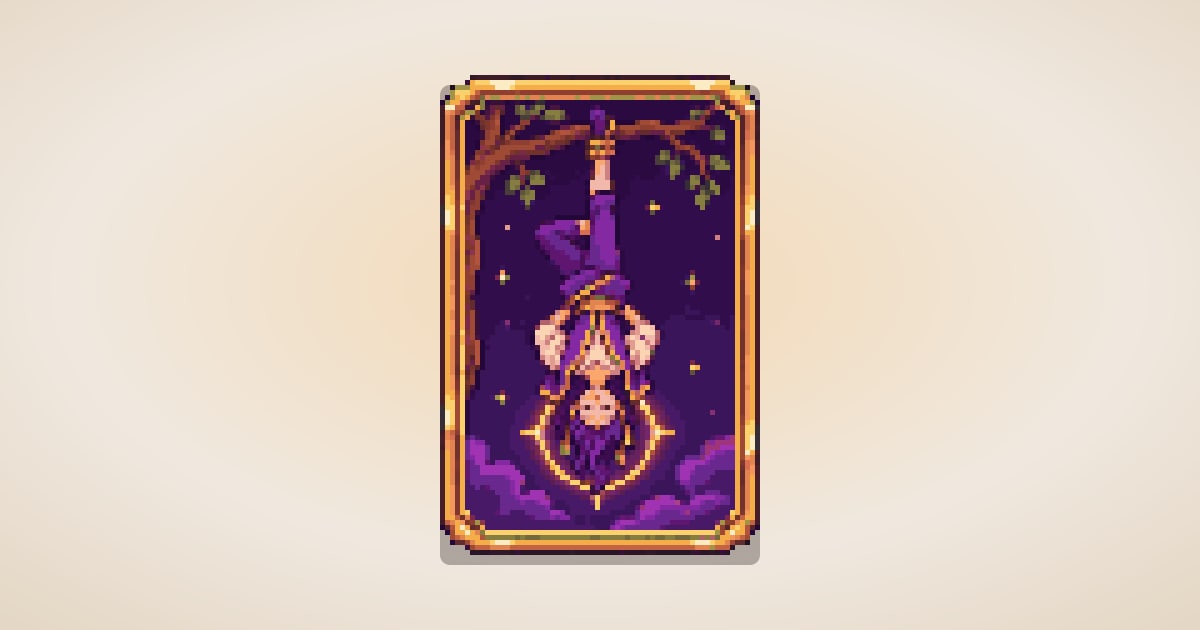 ReflectionsThe Hanged Man and the Long WaitOn the card of suspension, the face that stays calm upside down, and what a long pause can let us see.
-
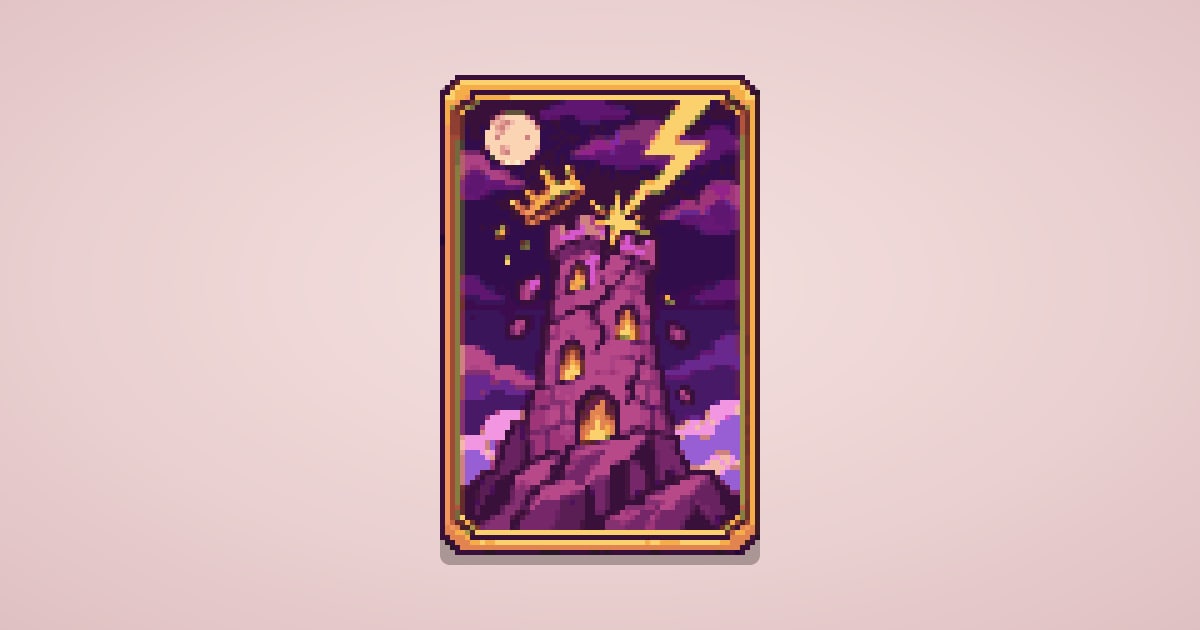 Card Deep DivesThe Tower Tarot Card: What It Means When Everything ShakesOne of the most feared cards in the deck, read slowly: what it shows, what it was once called, and why so many readers end up grateful for it.
-
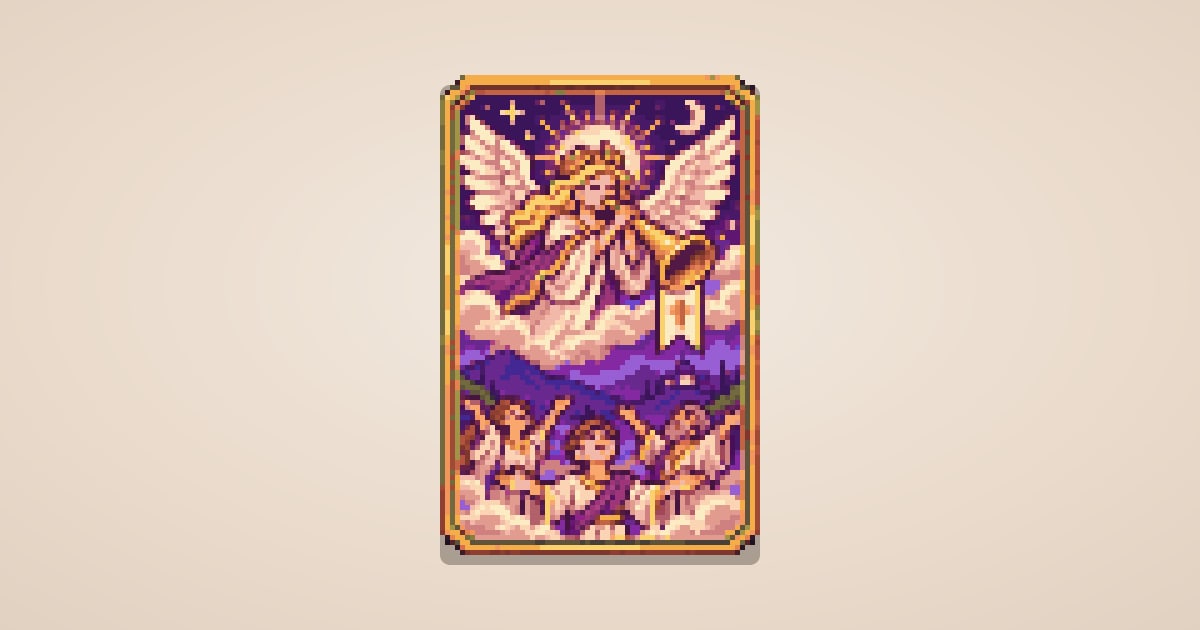 ReflectionsJudgement and Second Chances: Waking Up to Your Own LifeOn the card many people fear will condemn them, and why its picture looks less like a courtroom and more like a morning.