
Justice and Honesty With Yourself
On the card of fairness, the stories we tell about ourselves, and why a truly fair account leaves room for mercy.
 Justice · full meaning →
You are telling a friend about an argument, maybe with a sibling or a coworker, and you hear yourself shaping it. Their sharp words come out exactly as they were said. Yours get shorter. The moment you raised your voice becomes "and then things got heated." Your friend takes your side, and you still walk home with a stone in your shoe, because the story you told was not quite the story that happened.
This is ordinary. It isn't wickedness, only the wish to have been right. The card we turn to for the moment afterward, when some part of you wants the whole account, is Justice, card XI in the Rider-Waite-Smith deck.
Open eyes where you expect a blindfold
A crowned figure in a red robe sits on a stone seat between two gray pillars, facing straight out at you. One hand holds a sword, point up. The other holds a pair of golden scales, and the two pans hang level. Behind the seat a purple veil is stretched from pillar to pillar, so you cannot see what lies beyond it.
Many statues of Justice outside courthouses wear a blindfold. This figure does not. The eyes are open and level, meeting yours. We think that is the most important choice in the drawing, and it is easy to miss if you come to the card expecting the courthouse version.
Put it beside the Two of Swords and the difference gets sharper. There someone sits by the sea, eyes bound, swords crossed over the chest, keeping very still. Waite called that figure "hoodwinked." The Two can be a picture of keeping the peace by not seeing. If you never look at the choice, you never have to make it. Justice takes the blindfold off and shows the whole scene, including the part you would rather leave out.
Waite himself is almost no help with this card, and we would rather admit it. His whole entry is one sentence:
As this card follows the traditional symbolism and carries above all its obvious meanings, there is little to say regarding it outside the few considerations collected in the first part, to which the reader is referred.
Read generously, there is something fitting in that. He calls the meanings obvious, and most of the time they are. You usually sense already what fairness would ask of you. The hard part is looking.
When the blade turns inward
Looking honestly cuts both ways, though. The whole scene includes the parts that are kind to you: how tired you were, what else you were carrying, the times you got it right. The scales have two pans for a reason.
The sword in Justice is not swung. It is not aimed at anyone, least of all at the one who carries it. It stands straight up in the hand.
People who are hard on themselves tend to turn the blade around the moment they admit their part. "It was all them" becomes "I am a terrible person" in a single breath, as if the only alternative to denial were a sentence passed on yourself. That can feel like honesty. We don't think it is. Among the reversed meanings Waite listed for this card are "bias" and "excessive severity," and harshness toward yourself is still a tipped scale. It tips the other way, that's all.
A fair account sounds different. I raised my voice, and that wasn't fair to them. I was also worn out and worried, and the whole evening was hard. I can own my share without owning all of it. Less dramatic than denial or self-punishment, and much easier to live with.
Try it on a verdict you have already passed on yourself, something like I always ruin things. Ask how you would weigh the same story if a friend told it about themselves. Then add what belongs in the other pan: the context, the effort, the evenings that went well. Not to excuse anything. Only to make the weighing honest.
The white shoe at the hem
At the bottom of the robe, if you look for it, one white shoe shows at the hem, the foot set slightly forward. The figure is seated, weighing, but one foot has already moved. We read it as the most hopeful detail on the card. Seeing clearly is meant to lead somewhere.
Usually it leads to amends, and amends tend to be more modest than we fear. Not a grand confession. A message that says I've been thinking about Saturday, I was sharp with you, and I'm sorry. A borrowed book returned. A shared bill finally split the way it should have been. The next time you describe a conflict to someone, you might add one plain sentence about your own part and see whether the stone in your shoe gets lighter. Make the repair, then let it stand. One clear sentence is a foot set forward, and nobody needs you to mend the whole relationship at once.
Justice is often imagined as one great day of reckoning. In ordinary life it is closer to a habit, kept in moments nobody else sees. The day of reckoning belongs to a later card. Nine places on in the Major Arcana comes Judgement, the card of rising after a reckoning, and our essay on Judgement and second chances follows that later morning. Justice is the earlier work of getting the account right.
Sometimes there is nothing left to repair, or the other person cannot be reached, or should not be. Then the step forward is a change in how you carry it: doing it differently next time, and letting that count. If the regret itself is heavy, our essay on the Five of Cups keeps company with that slower grief.
A courtroom card that rules on nothing
Justice in a reading is about how we treat one another, not about how any court will decide. If you are facing a real legal matter, the card cannot tell you what will happen, and it is no substitute for advice from a qualified person. What it can ask is more modest. Whatever happens out there, are you being honest with yourself about your part?
If blaming yourself has turned into something darker, such as thoughts of not wanting to live, please tell someone now. Free, confidential help is listed on our safety page.
The figure on the card is neither angry nor afraid, and a true account of yourself can be given in the same way. Once it is given, you stand up and send the message.
Keep reading
-
 ReflectionsJudgement and Second Chances: Waking Up to Your Own LifeOn the card many people fear will condemn them, and why its picture looks less like a courtroom and more like a morning.
-
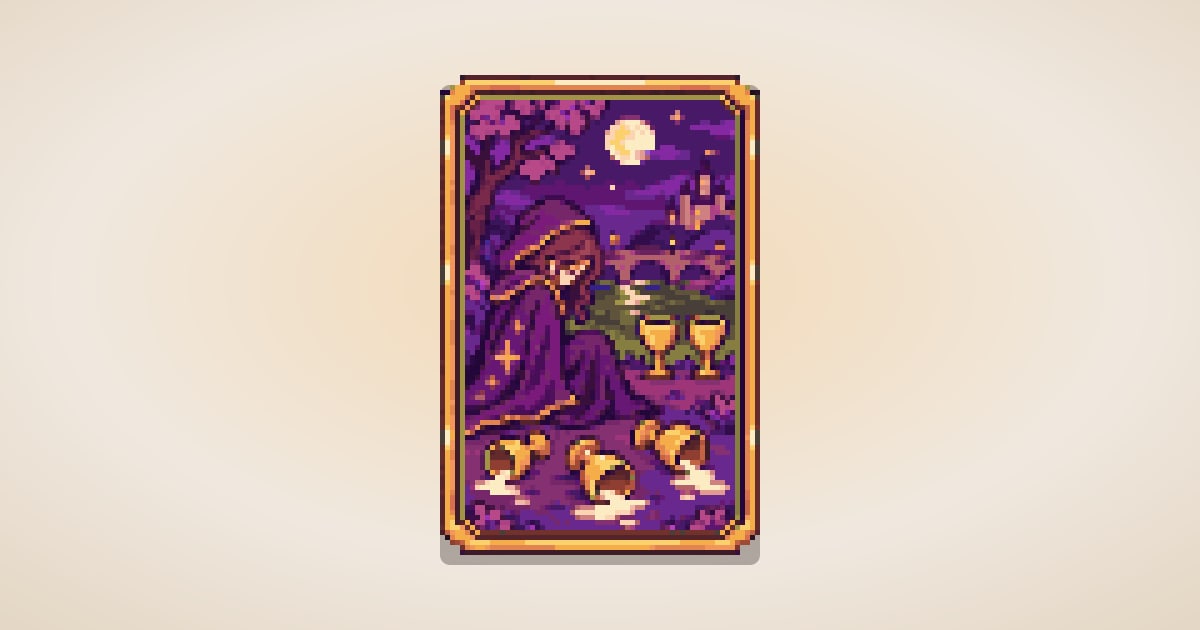 ReflectionsThe Five of Cups and Regret: Looking at What Still StandsOn the card of spilled cups, how regret narrows what we can see, and why nobody has to be hurried into turning around.
-
 ReflectionsStrength and Gentle CourageOn card VIII, a lion that is calmed rather than beaten, and the kind of courage that rarely looks brave from the outside.