
Tarot Journal Prompts: 40 Gentle Ideas for Self-Reflection
Questions to write beside the card you drew, grouped by purpose, and not one of them asks the cards to tell the future.
A tarot journal prompt is a question you write beside the card you drew, so the picture has somewhere to go. The forty below are grouped by purpose: prompts for any card, for the Major Arcana, for each of the four suits, for reversals, for a three-card spread, for hard days, for good days, and for looking back after a week or a month.
All of them are open-ended. None of them asks what will happen, because a card cannot know that, and a journal does not need it to. If you are new to this, choose one prompt, write for a few minutes, and stop. That is a whole session.
How to use prompts without pressure
A prompt is an offer, not homework. Skip any that feel heavy, rewrite any that feel slightly off, and answer in one sentence if one sentence is what you have. Some days the honest answer is "nothing comes up," and that still counts.
Three small habits make the prompts work better:
- Look before you look it up. Spend a minute with the picture first, so your first answer is your own rather than a guidebook's.
- Write the way you talk. Plain words to a friend beat polished paragraphs that nobody, including you, will reread.
- Keep answers tentative. If something you wrote starts to sound like a verdict on your life, turn it back into a question.
For what to write around the prompts, such as the date, your question and a short entry format, see our guide to starting a tarot journal. If you prefer paper, the printable journal templates leave room for all of it.
Prompts for any card
These fit every card in the deck, so they are a good place to begin.
- If I had to describe this card to someone over the phone, what would I mention first?
- What is the mood of this scene in one word, and where did I meet that mood this week?
- Is anyone in the picture looking at something outside the frame? What might be there?
- What is the figure holding, and what am I holding on to at the moment?
- If I could step into this landscape, where would I choose to stand?
- Which part of this card's usual meaning do I disagree with today, and why?
Prompts for the Major Arcana
The 22 Major Arcana are the named cards, from The Fool to The World, and many readers treat them as larger themes in a life. Our lesson on the Major Arcana walks through their order. These prompts are for sitting with one of them.
- This card already has a name. What would I call it, going only by how it looks to me?
- Where is this theme already present in my life in a small, everyday form?
- Which earlier period of my life does this card bring to mind, and what did I learn then?
- If this card were a doorway, what would I want to put down before walking through?
- Of the two cards on either side of it in the sequence, which feels closer to where I am?
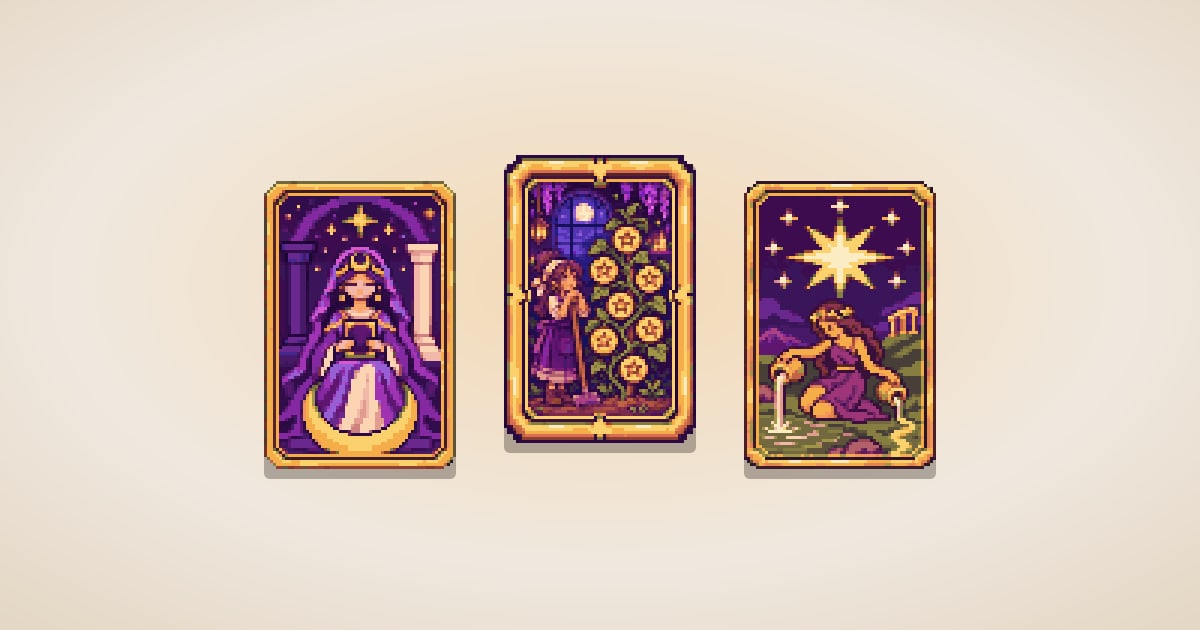
Take The High Priestess, seated between two pillars with a scroll half hidden in her robe. Prompt 7 might give you a private name for her, such as "the one who waits," that says more to you than the title printed on the card.
Prompts for each suit
Readers commonly link Wands with drive and action, Cups with feelings and relationships, Swords with thoughts and words, and Pentacles with work, money, the body and practical care. The lesson on suits and elements explains where those links come from. Two prompts per suit:
Wands
- What am I genuinely excited about right now, even a little?
- Where is my energy actually going, and is that where I want it to go?
Cups
- What feeling have I been carrying around all week without naming it?
- Who do I feel close to lately, and who do I quietly miss?
Swords
- What sentence keeps repeating in my head, and is it a fair one?
- What do I need to say more plainly, to someone else or to myself?
Pentacles
- What has my body been asking me for that I keep postponing?
- What small, practical thing could I tend today, the way someone waters a plant?
Prompts for reversed cards
Reversals are optional. If you read them, decide before you shuffle what an upside-down card will mean for you. Our lesson on reversals and the longer guide to reading reversed cards compare the usual approaches. Whichever you choose, these prompts treat a reversal as a turn in the theme, never as a warning.
- If this card's theme were slowed down or blocked somewhere in my life, where would that be?
- Do I have too little of this card's energy right now, or too much?
- What one small step would turn this card a little closer to upright?
- Does the upside-down picture show me a detail I overlooked when it was the right way up?
Prompts for a three-card spread
Three cards in a row are often read as past, present and future or as situation, action and outcome. Either way, the third card works best as a direction to consider, not a forecast.
- Read left to right like a comic strip, what story do these three pictures tell?
- Which card feels most like me today, and which feels furthest away?
- Do any figures face toward one another, or turn away? What might that say about the parts of my situation?
- What connects the first card to the last, and what does the middle card add?
- If the third card were a path I could choose, what would choosing it look like this week?
Prompts for hard days
On a hard day, a prompt should ask for very little. If writing feels like too much, close the notebook: that is a good answer as well. For something gentler still, a card for a hard day offers three slow breaths and one card.
- What is one thing in this card that looks soft, warm or safe?
- What do I need in the next hour that I could ask someone for?
- What have I already managed today, however small it seems?
- If the figure in this card could sit with me for a while, what would we do?
If the heaviness has lasted a long time, or you have begun to think about ending your life, set the cards aside and reach out to someone today. Our safety page lists crisis lines for many countries.
Prompts for good days
Good days deserve a page too, partly because they are easy to forget once a harder week arrives.
- What went well today, and what part did I play in it?
- Who or what would I like to thank, even silently?
- Where in this card can I see something of how today felt?
- What would I like to remember about this day on a day that feels harder?
Prompts for looking back after a week or a month
Read your earlier entries first, all the way through, then answer these.
- Which card from this stretch do I keep thinking about, and why that one?
- What did I understand about an earlier entry only after some time had passed?
- Which suit, or which mood, filled most of these pages?
- What would I like to carry into the next week or month, and what can I set down?
The Star, a kneeling figure pouring water out, sits well beside prompt 40.
Keeping the pages
Paper works, a notes app works, and so does an old exercise book. In the Emberlune app, Luna keeps readings and reflections in a private journal, but nothing here requires it.
Whatever you write in, the prompts will still be here next time. Pick one, draw a card if you like, and give it five honest minutes. When you want a fresh question to open a reading with, the sixty questions to ask tarot cards pair well with these.
Keep reading
-
 Self-DiscoveryHow to Start a Tarot Journal You'll Actually Want to KeepA five-line entry you can write in two minutes, how to spot the cards that keep coming back, and what to do when you read old pages.
-
 Learn TarotQuestions to Ask Tarot Cards: 60 Gentle Questions That Actually WorkA question bank for the days when you want to draw a card but cannot quite find the words.
-
 Self-DiscoveryA Morning Tarot Ritual: A Gentle Five-Minute Daily PracticeOne card with your tea or coffee, three plain questions and a line in a notebook, kept small enough that a missed morning never feels like failing.