
How to Read Reversed Tarot Cards: A Calm, Practical Guide
An upside-down card is the same card with its theme turned a little, and you get to decide, before you shuffle, what that turn will mean.
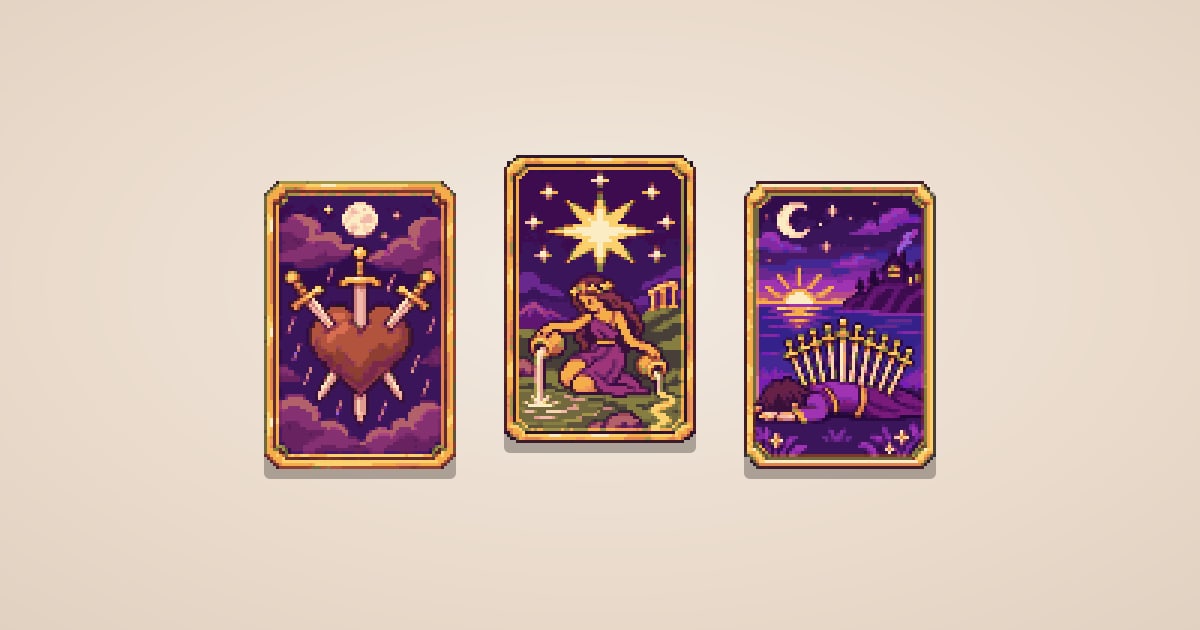
A card lands upside down, and for a second the picture looks wrong, as if the deck has said something worse than usual. It hasn't. A reversed card is the same card, with the same picture and theme. The only new thing is a question about how that theme is moving.
So what do you do with it? You don't have to read reversals at all. If you want to, choose one way of reading them before you shuffle, use it every time for a while, and treat each reversed card as its upright theme changed in that one particular way. Then judge the result by whether it helped you think, not by whether it sounded dramatic.
Should you read reversals?
Plenty of careful readers keep every card upright for years and let the question, the position and the neighboring cards show how a theme is going. Others like reversals because they add nuance to a small spread, where one or two cards carry a lot. A few questions can help you decide:
- Do the upright meanings feel familiar yet? If you are still learning the pictures, reversals can wait.
- Do you tend to read upside-down cards as bad news? A gentler rule may help, or you may prefer a practice without them.
- Are your readings short? A single daily card gains more from orientation than a ten-card spread that already has plenty to say.
Either choice is a complete way to read tarot. Neither is more serious or more advanced.
Six ways readers interpret a reversed card
Readers do not agree on what a reversal means. The reversals lesson in our course compares five approaches in a table; here they are with a sixth, and a note on when each tends to fit.
- Blocked or delayed. The theme is present but not flowing yet. This suits questions about plans and effort.
- Turned inward. The theme is happening privately, felt but not yet shown. This suits questions about feelings and self-understanding.
- Softened or excessive. The theme is quieter than usual, or there is too much of it. A reversed Three of Cups can read as a celebration that has tipped into overdoing it. Many readers use this for court cards: too much or too little of what that person stands for.
- Easing. For the hardest pictures in the deck, the reversal shows the pain loosening its grip. Many modern readers read the Three, Nine and Ten of Swords this way.
- The opposite. The reversal flips the theme. This is the approach that frightens people most, because a bright card can seem to turn dark.
- No reversals. Turn every card upright and read its whole range in context.
The early guidebooks don't follow one tidy rule either. A. E. Waite gave a reversed meaning for each card in his 1911 book, and his choices often surprise modern readers. For the Star, which most readers today call a card of hope, he wrote:
Arrogance, haughtiness, impotence.
For the Ten of Swords, a figure lying under ten blades, his reversed list is surprisingly bright:
Advantage, profit, success, favour, but none of these are permanent; also power and authority.
Reversed meanings have always been a matter of approach, so you are allowed to choose yours.
Choosing a rule and staying with it
The most useful thing you can do is decide what reversals mean before the cards are on the table. Decide afterward, and it is easy to pick whichever meaning matches your hopes or fears, so the reading quietly turns into an echo.
Write your rule down in one sentence, in your own words. "A reversed card shows its theme blocked or still forming." "A reversed hard card is easing; any other reversed card is turned inward." Two parts are fine. More than that tends to become a menu you choose from after the fact.
Keep the rule for a set stretch, such as ten readings or a month of daily cards, then read back through your notes. If the reversals mostly felt confusing or heavy, dropping them is a perfectly good outcome.
What your shuffle does to reversals
Reversals are physical before they are a meaning. A new deck usually comes with every card facing the same way, so nothing lands reversed until some cards are turned. Our guide to shuffling covers the hand movements; here is what they mean for orientation.
- If you never turn any cards, reversals appear only by accident, from a dropped card or a careless flip. Some readers count those; others turn them upright.
- If you turn part of the deck and mix it in, how many cards land reversed depends on how much you turned and how thoroughly you mixed.
- If each card is about as likely to land one way as the other, a three-card spread will come up entirely reversed about one time in eight, and entirely upright about one time in eight. A spread full of reversals is ordinary chance, not a warning.
- If you turn cards upright after each reading, the deck slowly drifts back toward upright. If you return them as they came out, the mixture stays.
- How you reveal a card matters. Flipping a card end over end gives the opposite orientation from flipping it sideways like a page. Pick one and keep it.
Three reversed cards, worked through
These examples are illustrative, not real readings. Each one uses a single rule, stated first, so you can see the reasoning.
The Three of Swords reversed, read as easing
Suppose you ask, "What do I need to understand about the hurt I'm still carrying?" and the Three of Swords lands reversed. The picture is plain: a heart, three blades, rain behind. Read as easing, the reversal doesn't remove the swords. It suggests the storm behind the heart is thinning. A reflection might be: "This still hurts, and it hurts a little less often than it did." A small action could be writing down one thing you can do now that you couldn't a month ago. If the hurt is grief, our piece on tarot and grief goes further.
The Star reversed, read as blocked
Now suppose you ask, "What could help me feel hopeful about the year ahead?" and The Star appears reversed. Read as blocked, the hope in this card is real but hard to reach right now. The figure is still pouring water; the question is what is in the way. A reflection might be: "I have been waiting to feel hopeful before doing anything hopeful." A small action could be one hopeful thing done without the feeling: a walk at dusk, one message to a friend.
The Ten of Swords reversed, read as turned inward
Finally, suppose you ask, "Where am I in this hard stretch at work?" and the Ten of Swords lands reversed. Read as turned inward, the ending may already have happened on the outside while you are still catching up with it on the inside. The picture has a yellow line of dawn on the horizon; the inward reading asks whether you have let yourself look at it. A reflection might be: "The worst part is over, and I'm still acting as if it's coming." Our essay on the Ten of Swords and the dawn spends longer with that picture.
None of these readings predicts anything. Each offers a thought to test against your actual life, and you can set it aside if it doesn't fit.
When most of a spread comes up reversed
A spread with several reversals can look alarming, but by the arithmetic above it is often just chance. With a "blocked" or "inward" rule, a mostly reversed spread can be read as one theme: a lot is happening beneath the surface, or a lot is waiting. That is a description, not a verdict. Look first at any upright cards, which often show where things move freely, and see our guide to card combinations for reading cards together.
If a spread leaves you anxious, you can stop. Close the deck and leave the reading unfinished; there is no need to return to it. The safety page has more support if a reading stays with you.
A turn, not a warning
An upside-down card asks you to look at its picture from a slightly different angle. With a rule chosen in advance, it can sharpen a reading; without one, you can simply turn it upright. A card of the day is a calm place to try reversals, and if you read in the Emberlune app, Luna keeps each reading in your journal so you can look back at how your rule held up.
Keep reading
-
 Learn TarotHow to Shuffle Tarot Cards (and Draw Them): A Calm Beginner's GuideA comfortable shuffle, a clear question, and a simple way to draw are enough to begin.
-
 Self-DiscoveryHow to Start a Tarot Journal You'll Actually Want to KeepA five-line entry you can write in two minutes, how to spot the cards that keep coming back, and what to do when you read old pages.
-
 Learn TarotHow Does Tarot Work? An Honest AnswerTarot has no proven power to predict events, and it can still help you think. Here is how pictures, chance, structure and a pen do the work.