
The Queen of Swords and Clear Kindness
On the tarot's most clear-eyed queen, the sorrow behind her composure, and how to say a hard thing plainly and warmly at the same time.
 Queen of Swords · full meaning →
"Her countenance is severe but chastened; it suggests familiarity with sorrow." That is Waite on the Queen of Swords, and it is one of the best sentences in his whole book. Most short guides turn her into the cold queen, the sharp one, the woman who cuts. Waite saw something else in her face, and so do we.
Severe but chastened
Look at the card before reading anything about it. The queen sits high on a stone throne, and we see her from the side, turned toward something past the edge of the picture. Her sword stands straight up in one hand. Her other arm is lifted with the hand open, or as Waite put it, "the left hand is extended, the arm raised". The throne is carved with butterflies and the winged head of a cherub. Clouds gather low behind her, down at the level of the land, and above her, in open sky, one bird flies alone.
Chastened is the word to stay with. It means corrected by experience, humbled by it. Waite's list of meanings for this queen is a sad one, beginning with "Widowhood" and running through "absence," "mourning" and "separation." In his reading she was a woman who had lost someone. Her severity, then, is not the hardness of a person who has never been hurt. It is the plainness of someone who has been, and who no longer has the patience for pretending.
Loss does that to many people. After a real grief, the polite yes you didn't mean and the silence kept to avoid a scene can start to feel unbearable. What is left is often plainer and truer. We should be careful here. Nobody needs to suffer to see clearly, and sorrow is not good for you. But the picture puts the clouds below her. She has come up out of them, and the air where she sits is clear.
Waite also wrote, "It does not represent mercy," and added, "and, her sword notwithstanding, she is scarcely a symbol of power." Readers disagree about how warm to make her. We read more kindness into that open hand than Waite did, and we would rather say so openly than pretend he agrees with us. Even in his stern version, though, she isn't someone who wounds for the fun of it.
A sword whose hilt rests on the chair
There is a detail in Waite's description that most people skip. The hilt of her sword "rests on an arm of her royal chair." She isn't gripping it with all her strength. The throne takes part of the weight.
We think this is the most practical thing on the card. When you dread a hard conversation, you tend to overbuild it: three reasons, two examples, a defense ready for every reply. The queen's way is lighter. She says what is so and lets it stand, because a true sentence is heavy enough without being pushed.
Suppose you have been covering a colleague's Saturday shifts for months and can't keep doing it. The overbuilt version runs to a paragraph of apology, or stays unsaid until one tired evening it comes out all at once and much sharper than you meant. The queen's version fits in one breath, followed by one warm thing that is also true. I can't take the Saturday shifts anymore. I like working with you, and I want to keep doing the weekdays well. Then you stop talking and let the other person answer.
That last part is the open hand. If the sword is the honest word, the raised hand is everything that comes with it: I'm still here, I still care, you can reply. Both of her hands are busy at once. She doesn't pick between clear and warm.
Her reversed meanings show what happens when the hands come apart. Among them Waite listed "Malice" and "artifice", truth used to hurt, or truth arranged cleverly to win. That is the sword without the hand, and it is the version of this queen most people have in mind when they call her cold.
Beside the Queen of Cups and Justice
She makes more sense beside the Queen of Cups, who sits at the water's edge gazing into a closed cup. That queen looks inward, at feeling. The Queen of Swords looks outward, as though someone were standing across from her waiting to hear. One cares by feeling deeply. The other cares by seeing clearly and saying so. Our essay on the Queen of Cups and tenderness follows the first way; this card is the second, and we don't think either is the better one.
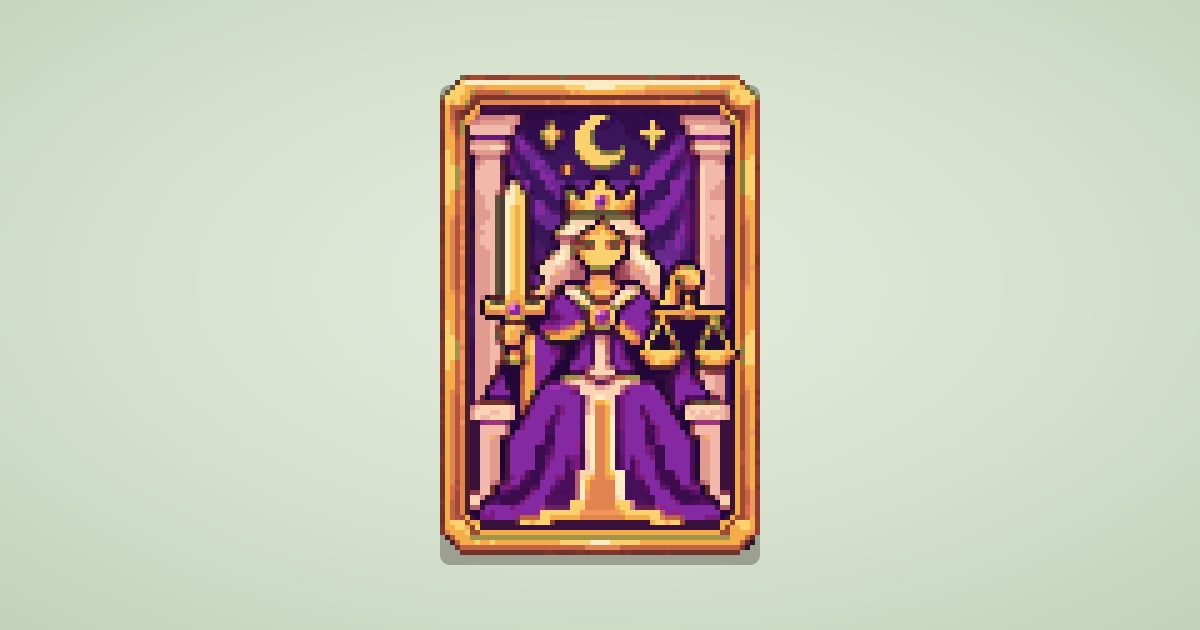
She also has an older relative in Justice, who faces us straight on with sword and scales. Justice is the principle. The queen is a person practising it, in profile, in a conversation, in an ordinary room. Justice never has to sit across from anyone. The queen does. For honesty that starts with yourself, read Justice and honesty with yourself.
When she seems to be someone you know
People often wonder whether this queen is a particular person in their life, a sharp boss, a mother, an ex. It is a natural thing to wonder, and the card can't settle it. No card can tell you who someone is or what they feel about you. Our guide to reading court cards makes the same point: the courts read better as roles than as verdicts on real people.
We find it more useful to treat her as a way of speaking that anyone can take up, of any age or gender, for the length of one honest sentence. If she appears when you are asking about someone else's feelings, turn the question around. What do you feel, and could you say it plainly?
Some people blur the edges of what they mean until nothing is left. Others wait until the words come out sharp. Most of us lean one way or the other, and it isn't a flaw of character. It is only the lean, and the queen sits upright.
Clarity can feel a little lonely at first, like that one bird in the open sky. It also means you can stop rehearsing the sentence in the dark.
The full Queen of Swords meaning, upright and reversed, is on her card page.
Keep reading
-
 Learn TarotHow to Read Tarot Court Cards: Pages, Knights, Queens and KingsSixteen figures, one simple method: read the rank as a way of carrying the suit, then let the picture and your question show who the card is about.
-
 ReflectionsJustice and Honesty With YourselfOn the card of fairness, the stories we tell about ourselves, and why a truly fair account leaves room for mercy.
-
 ReflectionsJudgement and Second Chances: Waking Up to Your Own LifeOn the card many people fear will condemn them, and why its picture looks less like a courtroom and more like a morning.