
A Monthly Tarot Spread for the Start of a New Month
Five cards that turn the first days of a month into a quiet check-in, with a question waiting for you at the end.
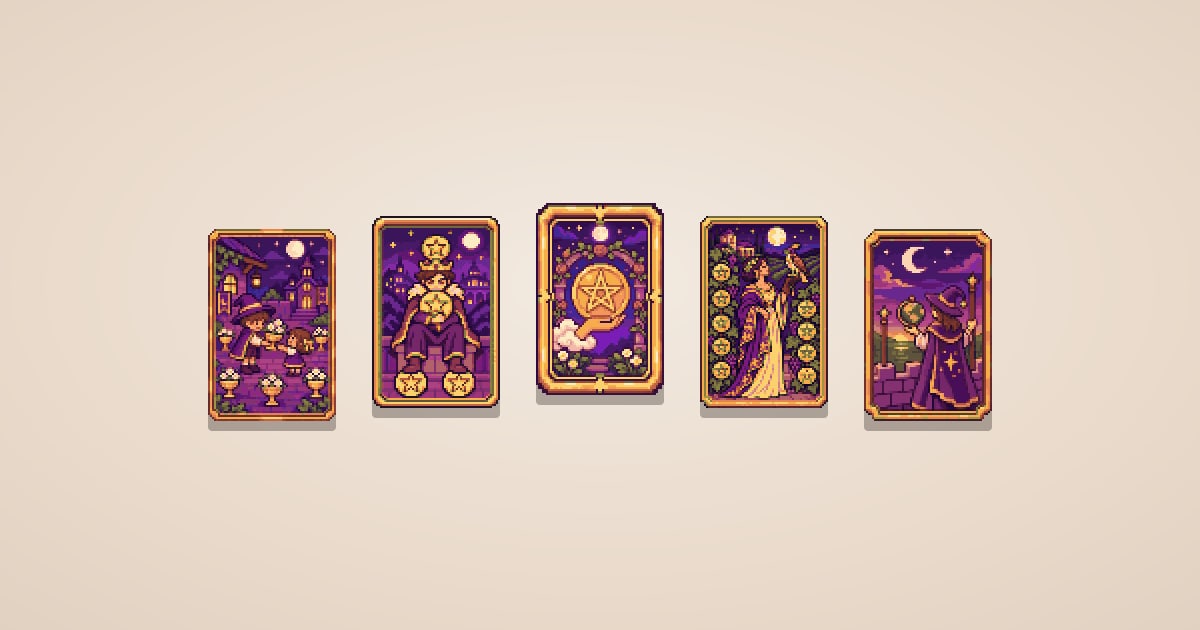
A monthly tarot spread is a short reading you do in the first few days of a month to decide how you want to meet it. The one below uses five cards: something to carry over from last month, something to set down, a focus, a gift to give yourself, and a question to come back to when the month ends. It takes about twenty minutes and a notebook.
What it will not do is tell you what the month holds. This spread does not try to forecast anything. Each position is an invitation to think, and the cards supply pictures to think with. The month itself stays open, which is the point.
Why the first of the month works well
A month is a convenient size for reflection. A day is too short to see much change, and a year is too long to hold in mind. Four or five weeks is long enough for a habit to settle or slip, or for a small plan to be tried and adjusted.
The start of a month also arrives on its own, without waiting for a moon phase or a birthday. A calendar page turns, and that ordinary marker makes a natural moment to pause.
If you already follow the moon, the new moon tarot spread and the full moon tarot spread offer a different rhythm, built around an intention and a review roughly two weeks apart. The monthly spread can sit alongside them or replace them. Choose whichever calendar you actually look at.
The five-card monthly layout
Shuffle in whatever way feels comfortable, and decide before you begin whether you will read reversed cards. If you have not settled on a rule, the course lesson on reversals can help, and reading every card upright is a perfectly good choice.
Lay the cards in a small cross: last month on either side, the focus in the middle, the gift beneath it like ground to stand on, and the question at the top, where your eye lands first when you come back.
 1Carry over2Set down3Focus4A gift5Month-end question
| Position | Name | What it invites you to consider |
|---|---|---|
| 1 | Carry over | What from last month is worth bringing with me? |
| 2 | Set down | What can I put down, at least for these few weeks? |
| 3 | A focus | Where would I like a little more of my attention to go? |
| 4 | A gift to myself | What small kindness could I give myself this month? |
| 5 | A question to return to | What do I want to ask myself on the last day? |
What each position asks of you
Carry over. Start by looking back. Something from last month deserves to continue: a conversation that went well, a walk you kept taking, a lesson learned the hard way. Let the card's picture point you toward it. You are choosing what to keep, so it can be something modest.
Set down. This is the card for whatever you have been gripping. It might be a task that no longer needs you, an expectation borrowed from someone else, or a worry rehearsed so often it has worn a groove. Setting it down can be temporary. You can pick it back up next month if it turns out to matter.
A focus. One focus, not a list. This position works best when the answer is small enough to notice on an ordinary Tuesday. "Be healthier" is a wish; "cook at home twice a week" is something you can see happening or not happening.
A gift to myself. This card asks for something kind and specific: an hour that belongs to no one, a library visit, an early night after a long day. If the picture shows something out of reach, ask what smaller version is available.
A question to return to. The last card is not answered today. Turn its picture into a question and write it on the top line of the page. At the end of the month you will reread it before anything else. A good month-end question is one you can answer honestly in a sentence, such as "Did I make room for the thing I said mattered?"
An illustrative reading
Pair it with a daily card and a month tracker
The spread gives the month a shape. A daily card gives it texture. If you like, draw a card of the day each morning, or whenever you remember, and write one word beside it on the printable month tracker: thirty-one small boxes, one per day, with space at the bottom for the cards that came back.
Let the daily word describe the day, not the spread: you are noticing what Tuesday was like, not checking whether it "confirmed" your focus card. Skip days freely, too. A tracker with gaps still tells you something, and a missed morning is not a broken streak.
If one card starts turning up often, consider chance and your shuffle before reading anything into it. Our article on drawing the same card again and again walks through both.
Revisit it at the end of the month
The return visit is where this spread earns its place, so put it in your calendar now: the last day of the month, or a quiet evening near it.
A month that went sideways still leaves useful notes. A focus that was too big, or a gift crowded out in week two, is information for next month's spread, not a failure of this one.
Adapting the spread
You can change any position that does not suit you; the guide to making your own tarot spread explains how to test a new one. On a heavy month, three cards may be plenty: keep the carry-over, the gift and the question, and let the rest wait. If the start of a month brings up grief or dread, a single card for a hard day can be kinder than a full layout, and our safety page has helplines if things feel like too much.
If you would rather keep each month's reading on your phone, Luna in the Emberlune app can save it to a private journal, so the month-end visit starts with your own words from the first day.
Sources
- A. E. Waite, The Pictorial Key to the Tarot (1911), for the descriptions of the card pictures. The reflective uses of each card above are our own.
Keep reading
-
 Tarot SpreadsA New Moon Tarot Spread for Gentle IntentionsMake room for one small beginning, with enough care and support to give it a fair try.
-
 Self-DiscoveryHow to Start a Tarot Journal You'll Actually Want to KeepA five-line entry you can write in two minutes, how to spot the cards that keep coming back, and what to do when you read old pages.
-
 Tarot SpreadsA Weekly Tarot Spread: Four Gentle Cards for Sunday EveningFour cards and ten quiet minutes before the week begins, with a short look back on Friday to see what actually happened.