
A Tarot Spread for Making a Decision: Seven Cards for Two Paths
The cards will not pick a path for you, but laid out with care they can help you hear your own reasons more clearly.
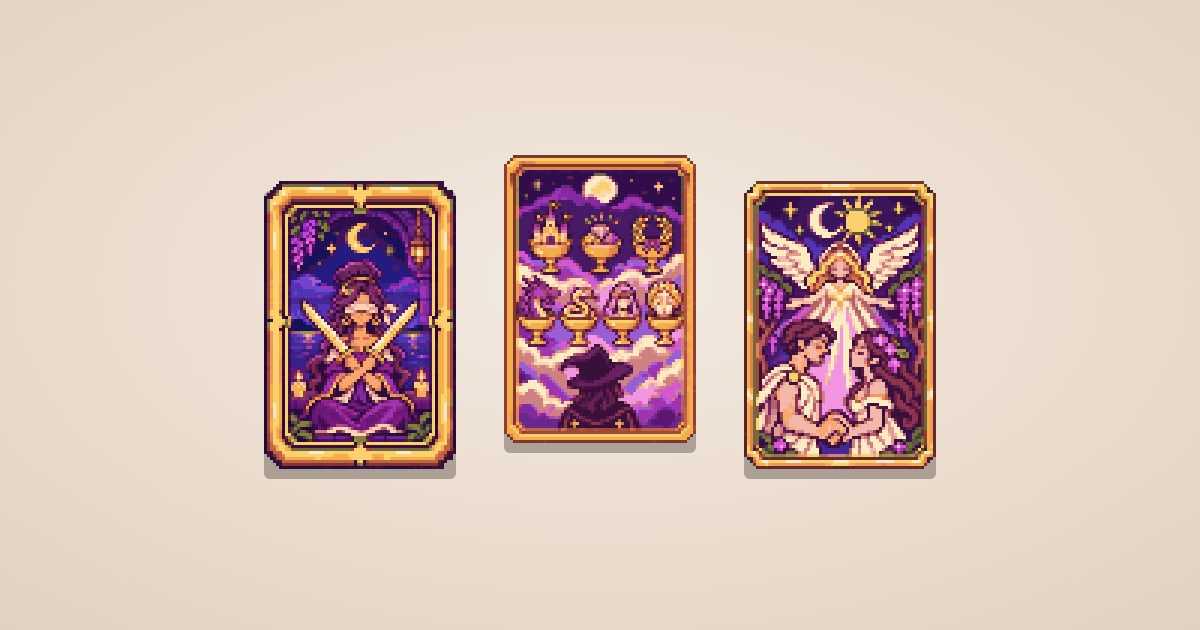
When a choice has been going around in your head for weeks, it can help to get it onto a table. A tarot spread for making a decision gives each part of the problem its own place, so you can look at one piece at a time.
Here is the honest part, up front. The cards do not know which path will work out, and they cannot choose for you. What a good decision spread can do is slow you down, separate the options, and give you pictures to think with. Often the most useful moment in the reading is when you notice a reason you already had but had not said out loud.
The seven positions
Shuffle in whatever way suits you, then lay out seven cards in this order. Each position is written as a question, because a question gives you somewhere to start.
- What I want underneath this choice. Not the option itself, but the need behind it: rest, security, growth, closeness, freedom.
- Path A as it feels now. How the first option sits with you today, before you have done anything about it.
- What A asks of me. The effort, change or cost this path would require.
- Path B as it feels now. How the second option sits with you today.
- What B asks of me. What this path would require in return.
- What I am afraid of. The worry that may be steering the decision without telling you.
- What I already know. Something you are sure of, whatever you decide.
How to lay the cards out
Picture a small house. Card 1 sits alone at the top, like a roof. Below it are two columns: Path A on the left, with card 2 above card 3, and Path B on the right, with card 4 above card 5. Along the bottom, card 6 goes under the left column and card 7 under the right, so your fear and your knowing sit side by side at the foundation.
| Left | Center | Right |
|---|---|---|
| 1. What I want underneath | ||
| 2. Path A now | 4. Path B now | |
| 3. What A asks | 5. What B asks | |
| 6. What I fear | 7. What I know |
With the two paths side by side, you can compare them across the table, and card 1 above both lets you check each path against what you actually want. If you only have time to think hard about one card, we would choose that one. Most decision spreads spend their positions on the options. We think the need underneath does more work.
For a third option, add a column with one card for how it feels and one for what it asks. Beyond three, narrow the list on paper first.
Phrase the question around you
The question you write down shapes everything that follows. "Which job will make me happy?" asks the cards to see the future, which they cannot do. "What do I need to understand about choosing between these two jobs?" asks for reflection, which is something a reading can actually offer.
A few things help:
- Name both options plainly before you shuffle. "Path A: apply for the course this spring. Path B: wait until next year." Vague options lead to vague readings.
- Keep the question about your own choice. A spread cannot tell you what another person thinks or will do. If the decision depends on someone else, the honest next step is a conversation with them.
- Choose one decision per reading. If several choices are tangled together, pick the one that has to be made first.
For more ways to turn a worry into a workable question, see this list of questions for the cards.
When both paths look hard
Sometimes cards 2 through 5 all look heavy: a figure weighed down, a figure in the snow, swords everywhere. This can feel like a verdict. It is not one.
Most real choices cost something on both sides, which is why they are hard. A difficult card in a "what it asks" position is often plainly accurate, and that is useful information, not a warning. Compare what each path asks with card 1. A path that asks a great deal but serves what you want underneath may repay the effort. A path that asks less but drifts away from it may cost more than it seems.
Then look at card 6. When both options look grim, fear is often doing some of the talking. Name the fear as precisely as you can. "I am afraid I will run out of money" is something you can look into. "I am afraid of choosing wrong" is something nearly everyone feels, and it tends to ease once you accept that no choice comes with a guarantee.
The Two of Swords belongs in this conversation. In the Rider-Waite-Smith picture, a blindfolded woman sits holding two swords crossed against her chest, with water behind her. Many readers take it as the card of a stalemate held in place by not looking. If you draw it, you might ask what you have been avoiding looking at.


A sample reading: study now or wait
A shorter version for yes or no questions
Not every decision has two clear paths. Sometimes it is just "Should I do this?" For a quick single card, our yes or no tarot page is built for that kind of question. If you would like a little more room, try three cards:
- What a yes would ask of me.
- What a no would ask of me.
- What I already know.
This keeps the spirit of the longer spread: two sides, each with a cost, and one card for your own steady ground.
When a decision needs more than cards
A decision spread is a thinking tool, and some decisions need more than thinking alone. Put the deck aside and talk to a person if:
- the choice involves your health, your safety, a legal matter or significant money, where a doctor, lawyer, advisor or someone you trust can give you facts the cards cannot;
- you find yourself drawing again and again, hoping for a different answer, or feeling worse after each reading;
- the decision affects someone else closely, and the most honest thing is to ask them;
- you feel overwhelmed, frightened or unsafe. Our safety page lists places to turn.
Sometimes the clearest thing a spread shows is that you need company with the decision.
Other layouts to try
For a shorter layout, the four-card Crossroads decision spread covers where you stand, each path and a guiding card, and the tarot spreads page has others to try. You can also start with a free tarot reading and keep your two options written beside you. Readings done in the Emberlune app are kept in a private journal with Luna, which makes it easy to look back later at what you chose and why.
Whatever you decide, the decision stays yours. The cards are there to help you hear yourself think.
Keep reading
-
 Tarot SpreadsSituation, Action, Outcome Tarot Spread: One Step You Can TryThree cards can help you name what is happening, choose a response, and consider a possibility you can test.
-
 ReflectionsThe Lovers and Choosing With Your Whole HeartOn the card of two people under an open sky, the two trees behind them, and the unglamorous work of meaning your yes.
-
 Tarot SpreadsA Monthly Tarot Spread for the Start of a New MonthFive cards that turn the first days of a month into a quiet check-in, with a question waiting for you at the end.