
The Ten of Wands and Carrying Too Much
On the card of the heavy bundle, the responsibilities we pick up one at a time, and the slow work of carrying less.
 Ten of Wands · full meaning →
The Ten of Wands is the last numbered card of its suit, and the heaviest. The suit opens with one staff, offered from a cloud in the Ace of Wands. Ten cards later, a man is trying to carry all of them at once.
A man behind his staves
He walks across open country with ten long staves gathered in his arms. Both arms are wrapped around the whole bundle, holding it against the front of his body, so the staves fan out above his head like a stand of saplings. His back is bent. His head is bowed into the wood, and we cannot see his face at all. Some way ahead, past the fields, stand a house and a few trees at the edge of a town. He is walking toward it, though with his face pressed where it is, he may not be able to see it.
Waite's description of the picture is one sentence long:
A man oppressed by the weight of the ten staves which he is carrying.
He names the weight and the man under it, and nothing more. We find that plainness helpful. The card does not scold the man for carrying too much, and it does not praise him for it either.
Look closely at the staves. In his notes on the Queen of the same suit, Waite wrote that "The Wands throughout this suit are always in leaf, as it is a suit of life and animation." The ten in this bundle carry leaves too. The man is not hauling deadwood. Every staff in his arms was alive when he picked it up.
That is how overwhelm usually happens. Someone asks if you could take care of one minor thing, and it really is minor, so you say yes. Then a second thing, because you are already handling the first. Then a job nobody else saw needed doing, so you did it, and now it is yours. Months later you are standing in the kitchen at the end of a long day, trying to remember what you have forgotten, and you cannot say when all of it became this heavy. Nobody fills their arms with things they don't care about. You take the job because you wanted it, a friend's hard month because you love the friend, the extra project because it looked like a chance.
Waite seems to have understood this. Among his meanings for the card:
The chief meaning is oppression simply, but it is also fortune, gain, any kind of success, and then it is the oppression of these things.
Success can be heavy. So can love, and good luck, and being the one everybody counts on. We would go a step further than Waite: a load made of good things is often harder to put down than a load of bad ones, because every piece of it is easy to defend.
Then there is the hidden face. He has pulled the staves so close that they stand between him and the road. Carrying too much narrows what you can see. Days shrink to the next task, and the larger questions slip behind the wood. Is this still the road I want? Who is walking it with me? Waite added a stranger line: "The place which the figure is approaching may suffer from the rods that he carries." We read that as a plain observation about loads. They come through the door with you, as a short temper at dinner or listening with half an ear. That is no verdict on anyone. It is one more reason to look at the bundle honestly.
Last, the grip. He clutches ten staves upright against his chest, which is about the most awkward way to carry them. Tied and slung across his back, the same bundle would weigh exactly as much, be easier to bear, and let him lift his head. Some loads need to get lighter. Others only need carrying differently.
Sorting the bundle
This practice takes about half an hour and a sheet of paper. The order matters, because each step depends on the one before it.
- Write down everything you are currently carrying, one line each. Work, home, other people's problems, the jobs you took on without anyone asking. Keep going past the obvious ones until you have at least ten. Don't judge them yet.
- Next to each line, write how it came to you. You chose it. It was handed to you and never taken back. You picked it up because you moved first and now everyone assumes it is yours. Be honest, and expect a few surprises.
- Now go through the list again and mark each wand as keep, share or set down. A wand you would choose again is a keep. One that could be split with someone, if you said out loud that it was heavy, is a share. A few could probably be put down entirely, and the world would go on with very little fuss.
- Pick a single wand from the share or set down groups, ideally one you took over because it felt quicker than waiting for someone else, and hand it back this week, plainly and without a long apology. It may get done differently. That is often a fair price.
- Then pick one wand from your keep group and ask how it could be carried with less strain. Less often. To a good enough standard. Alongside someone. At an hour when you are not already spent.
- For the next few weeks, when someone asks for something new, answer with a sentence that buys time: "Can I think about it and tell you tomorrow?" Most new wands arrive in the half second between a question and an answer, so this is the step that keeps the list from growing back.
Steps four and six can take some nerve, the kind our essay on Strength and gentle courage explores: being willing to disappoint someone a little.
If the weight has gone past tiredness into something that doesn't lift for weeks, a doctor is a good person to tell. If you have started to feel you don't want to be here at all, tell someone today. Our safety page has free, confidential lines.
Still walking
This is not a card about stopping. That belongs to the Four of Swords, with its knight lying still in a chapel. The man on the Ten is still walking, and nothing in the picture tells him to drop everything in the field. The question it puts to him is more modest, and we think more useful: what if you arrived carrying less? The town is still some way off, and there is plenty of path between here and there for setting two or three staves down and lifting his head to see where he is going.
Keep reading
-
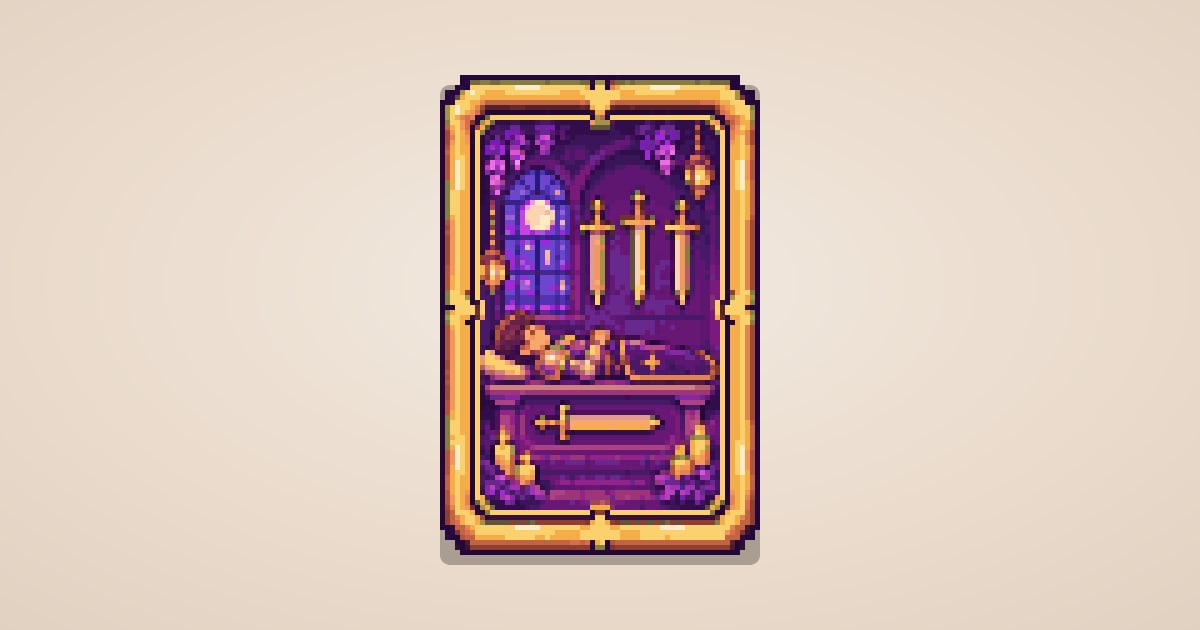 ReflectionsThe Four of Swords and Permission to RestOn the stillest card in the deck, one sentence of Waite read slowly, and why stillness is something we need, not something we win.
-
 ReflectionsStrength and Gentle CourageOn card VIII, a lion that is calmed rather than beaten, and the kind of courage that rarely looks brave from the outside.
-
 ReflectionsJudgement and Second Chances: Waking Up to Your Own LifeOn the card many people fear will condemn them, and why its picture looks less like a courtroom and more like a morning.